
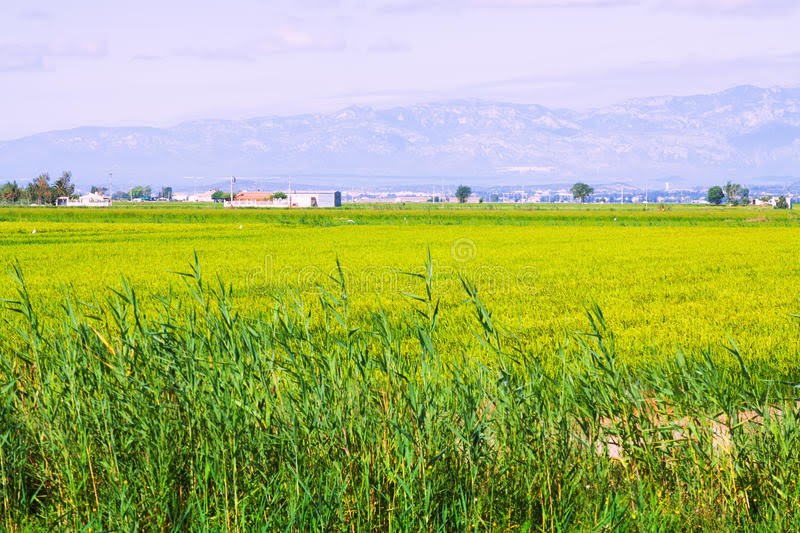

Undoubtedly, the great protagonist of the territory is our landscape. It changes considerably throughout the seasons, as the process lasts approximately one year.
Rice cultivation began in 1860, although there is evidence of some unsuccessful attempts several centuries earlier. Before that, people lived modestly from salt production, gathering, hunting and fishing, and livestock farming. It was with the construction of the Right Canal, which was initially intended to facilitate navigation, that people became aware of the great advantage it offered for irrigation. The first farmers faced an endless number of tasks, which they learned to carry out at a forced pace. They had to clear all the land, build irrigation channels and embankments, and level all the fields uniformly so that the water could flow in… all this bearing in mind that, at that time, it was a wild, muddy territory covered in vegetation. Day labourers and farmers from neighbouring regions, who already had experience, arrived, and this is how the Delta began to grow both demographically and in terms of urban development.
The way rice is cultivated has changed enormously. In the past, it was essentially manual, hard work that required many people. Fifty years ago, practically all tasks were carried out by hand, with the help of animals and very little machinery. Harvesting mobilised many families and groups of workers, and it was common for men, women and young people to take part. Today, it is a much more mechanised and organised activity. The need for labour has been reduced, but farmers’ knowledge is still essential to understand and interpret the land.
The agricultural cycle, both in the past and today, continues to have very similar stages, even though the way things are done has changed.
The cold winter months are used to rest and prepare the land. After the previous year’s harvest, the fields have spent the autumn with little water or flooded, depending on the management of each farm. Between January and March, tasks such as ploughing, puddling and repairing the embankments are carried out.
Spring is one of the most important and beautiful times of the year. Everything is filled with water to prepare for sowing, which is carried out by scattering the seeds directly over the flooded fields. After just a few days, the green shoots begin to appear and the magic begins.
When June arrives, the landscape is completely green and the plant gains strength to reach its peak. The farmer must pay particular attention to weeds and pests. During these months, it is common to see people working inside the fields, manually clearing the vegetation, as no type of machinery can enter while the crop is growing.
July and August are the golden season, both literally and metaphorically, as the plant and the seed are in their maximum growth and ripening phase. These are critical months for monitoring the quality and temperature of the water. Weather conditions can also be a risk factor throughout the summer, as heavy rainfall or hail could seriously affect the harvest and its yield.
September arrives, the most eagerly awaited time for farmers because it is time to harvest! Harvesters and tractors spread across all the fields like a plague, working day and night to collect all the rice from both hemispheres in the shortest possible time.
Once harvested, the grain arrives at the rice processing facilities to begin its final process before reaching our hands. There, it is cleaned, dried, milled and stored.
We could say that rice changed practically everything: the landscape, the economy, the villages, customs and even the way people live. Therefore, when we look at a rice field, we are not simply seeing a cultivated field; we are seeing the result of generations of work, resilience and knowledge of the land. Preserving this crop also means preserving part of the history, culture and identity of the Delta, while facing the environmental and economic challenges of the future.
At Viatges Nemon, we have two guided tour options for you to discover this entire story first-hand: Rice fields and flamingos in the Ebro Delta, or a visit to the «La Torra» the rice interpretation centre.





0 Comment